Monday, May 14, 2012


Two days without sleep. I'm getting good at this. 
And by this, I meant to say "at killing myself slowly, miserably, silently".

Friday, May 11, 2012

I'm done with college?!?!?!

Pardon the syntax of that question. I still can't believe it.

In order to phrase things properly, I feel the obligation to state two good news according to chronological order, level of relevance, and --- nah, those are the only two considerations.

1. I'm officially done with finals!

2. My senior show was on Monday! And I sold a couple of paintings and photographs!

3. I got accepted into Grand Central Academy of Art!

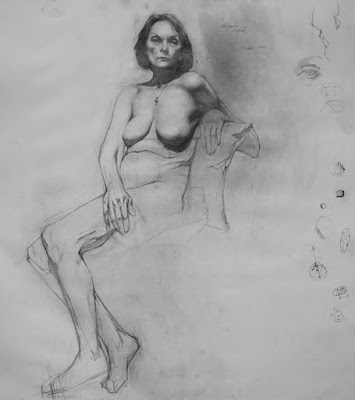
I have photographs of all of this, naturally, but first of all, a photo of my final for advanced drawing class, Sir Handsome Pepper, Carlos Gomez.

Sir Handsome Pepper, charcoal on paper, 2012

Friday, April 20, 2012

And debate what's truly permanent...


I'm leaving for New York in a couple of days, and I can't stop thinking about the Met. The Met, the Met, the Met, always the Met. I don't know how my schedule is going to work, but I hope I get to see Rembrandt's temporary exhibition because -- wait, why do I have to justify myself? It's Rembrandt!

Anyways, senior exhibit shenanigans. A very awful grisaille (I need to fix the fabric, I need to fix the fabric!)


I don't know what's happening to me, I feel myself aging. 

I see myself aging.

 I met with some friends, some dear friends, some freaking dear friends -- and I stated, without really thinking, about how much I need to be aware of my self-awareness. In other words, I understand that time gives perspective, but I wish I didn't have to rely on time to be aware of how beneficial or harmful my previous decisions have been. 

It is always a beautiful experience to look back, after a semester is over (such a nerd, such a nerd -- measuring time through semesters) and find out what the highlights were, but of course that's silly. I just want to make wise decisions. 

I'm always moving,
jumping,
looking at my wrists, that look tempting,
whenever I do something awfully wrong.

And I do many awfully wrong things often,
and I wish I didn't,
and I wish I didn't.  

I keep forgetting
that I am so damn sensitive.

I sleep with audiobooks,
I sleep with books,
they often end up next to my cheeks, and I always wake with the marks of the pages
on my skin,
but I sleep deeply,
oh, so deeply,
that I am unable to remember what I dreamt:
it's the time
when your eyes are closed but you are not asleep yet
what makes me feel terrified.

It's the monster inside the closet, I suppose. 

I contemplate, but I don't contemplate myself that much anymore.

(But I laugh, still. I laugh a lot.)

Monday, April 9, 2012

Monday Marvelous Masterpieces

I am currently fascinated by the drawings created by the Pre-Raphaelite brotherhood*. Arguably, they could be labeled as illustration, but I won't even go there. Let's enjoy things because they are good, not because we are conditioned to like things according to their label!

John Millais

Francis Bernard Dicksee's study of "Chivalry"

Dante Gabriel Rossetti

"Lilacs" by Millais.

"Study of Nimiji" by William Holman Hult


*I love Sir Joshua Reynolds, though. And the nineteenth century approach to art, entirely academic. But these drawings were exquisite as well.

A month away from my senior exhibit (and graduation)


Albert Camus' L’Étranger was one of those books that left me entirely speechless, and if anything, entirely empty back in high school. I still remember taking the little book and reading it in between classes, hiding it, covering it with notebooks, creating this sort of pathetic fort with rulers, pencils and all types of school supplies. Oh, I was very subversive and so punk rawk!


As I was reading the book again a few weeks ago, one of the instances described by the author triggered my imagination, and I completely pictured this scene (description from dear Wiki, as I didn't bring the book to campus):

Part One begins with Meursault being notified of his mother's death. At her funeral, he expresses none of the expected emotions of grief. When asked if he wishes to view the body, he says no, and, instead, smokes and drinks coffee with milk in front of the coffin. 


The absorption and recreation of a described scene according to the author, subjective to our experiences (what we instantly recall when the word "chair" is mentioned) is one of the best aspects of literature.

Friday, March 9, 2012

Spring Cleaning (kinda)


I can't believe it's almost Spring Break. Where's my mind, where's my mind, what's my age again? #00's
Posts about how time flies are pretty boring, though. Let's talk about fun stuff.

I need to finish this drawing on Marius Pontmercy during the break.


But I guess all the corrections stated by R. had made the task kind of overwhelming. It's silly, rather silly, isn't it?

Marius Pontmercy is such a charming character. Aaron was a wonderful selection for this piece and I am excited, very excited.


Many elements of Les Misérables can be analyzed through the critical perspective of Marxist theory. Victor Hugo's approach of Romanticism, concern with the working class and the adversities of this sphere make the struggle from exploitation to freedom (19th century concept of freedom, naturally) fundamental for the understanding of the novel. I feel like it's silly to romanticize poverty, though, and I've heard a few friends comment on Victor Hugo's "idealized depiction of the working class is offensive". But is he, really? It is certainly a different approach from Dickens', but offensive? I'd like to state that his dignification of characters like Fantine make the human experience real. In an ideal fiction novel, Fantine would be successful in her struggle to survive the terrible conditions of a prejudiced and conservative society that could not understand but the standard institution of family. But alas, she isn't! And she dies, surrounded by poverty and discrimination.

The novel attempts to cover the injustices of committed by the oppressors, that incidentally are the oppressed as well -- most of the time. The proletarian, the suffering class -- I am unable to spot a difference in between what Marx covered in his Communist Manifesto and what Victor Hugo described in Les Misérables. Both cover not a similar, but the exact subject matter: the impoverished working class, the degradation of man in the proletariat, the struggles of men to feed themselves and horrible consequences of minor crimes such as stealing bread, the oppression of women through hunger, etc.     

I feel like writing an essay. You know, for fun.